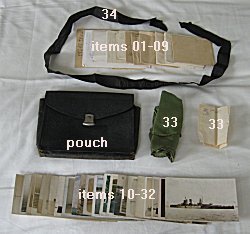
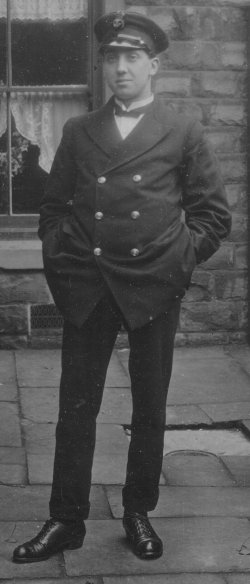
Information about William DOXEY consisting of 34 items, mostly postcards
and letters, found in a black leather pouch 20 cms x 15 cms with a metal clasp.
|
Item 01 Index
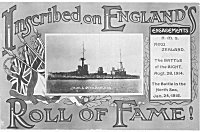
Postcard "Inscribed on England's
Roll of fame
HMS New Zealand"
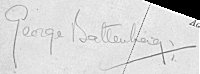
Signed on back by
"George Battenberg"

"Postcard from William Doxey in 1916.
Sent to parents after having been missing
for 3 weeks after Battle of Jutland
on HMS Lion.
Postcard approx 1916
signed by Lieutenant George Battenberg
later Milford Haven & Mountbatten"..... Ena

"Approx 1916.
Card signed at Scapa Flow
by George Battenberg
later Mountbatten (Milford Haven)
When he was serving on
HMS New Zealand as Midshipman
for Mr William Doxey
petty officer on battleship"........ Ena
|
Item 02 Index
A4 size letter from Admiralty
dated 13 July 1916
to Mr Henry E BOWEN
Electrical Egineer
Messrs Steel Peach & Lynn Ltd
Rotherham

"William Doxey .... Electrical Fitter...
attached to HMS Victorious...safe and well"
|
Item 03 Index
Letter from
Electrical Engineer's Department
Invergordon
27 Oct 1919

"W.Doxey ....employed in Electrical Department
of HMS Victorious....loyal and efficient manner
.....adverse conditions...cheerful and willing
....Period of employment 1915-1919"
|
Item 04 Index
Letter from
HM Dockyard
Chatham
16 Jan 1922

"W Doxey while employed on my staff 1915-1918
proved himself capable and efficient electrician
and can be well recommended as a worthy applicant
for admission to the Institute of Electrical Engineers"
|
Item 05 Index
Letter from
HMS Victorious
27 Sep 1918
"Mr W Doxey
Electical Fitter in Charge
HMS Revenge

Herewith forwarded Naval Permit No
D 4879"
|
Item 06 Index
Certificate of Service under the Admiralty
dated 16 Jan 1920

Dockyard:    Portsmouth
Department   Electrical
Date         16 Jan 1920
Name         William Doxey
Trade        Electrical Fitter
Hired        Hired
Service      22jan1915 to 23oct1919
Conduct      Very good
Quality      Very good
Discharge    Own request
Particulars  Includes four and a half years's service
             at Scapa on HM Ships afloat
             and on repair and maintenance
             of Electrical equipment of Floating
             Dock at that Base
|
Item 07 Index
(document very faint)

"14 Mar 1918, Electrical Dept, HMS Victorious
Mr Doxey
Forwarded for information of Wardale and Leader.
Work done in WARSPITE Electrical Engineer's Dept
HMS Victorious
H.F. 190/109
Rear Admiral
Cyclops
Much credit due...Electrical Engineer's Dept,
Victorious....very satisfactory...convey appreciation
....those concerned
(more but almost unreadable)
signed
W R Prendergast
Rear Admiral
Cyclops
14mar1918
|
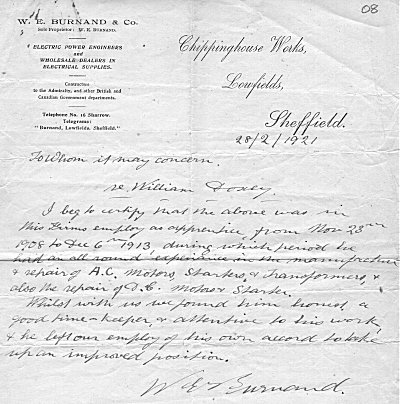
Item 08  Index
W E Burnand & Co
Electrical Power Engineers
Contractors to Admiralty
Chippinghouse Works
Lowfields
Sheffield
28 Feb 1921

28/2/1921
To whom it may concern
          Re: William Doxey
I beg to certify that the above was in this
firms employ as apprentice from Nov 23 1908
to Dec 6 1913, during which period he had
an all round exposure in the manufacture &
repair of AC motors, starters & transformers,
& also the repair of DC motors & starters.
Whilst with us we found him honest, a good
time-keeper, & attentive to his work, & he
left our employ of his own accord to take up
an improved position.
(signed) W E Burnand
|
Item 09 Index
American Institute of Electrical Engineers
33 West 39th Street, New York
17 Feb 1922

"receipt of your application for admission
to membership in this Institute.

...required number of endorsments...
posting of your name in our Journal....
submitted to Board of Directors...
you will be notified promptly...."
|
Item 10 Index
Postcard dated 27 Feb 1915
HMS Lion
Mr & Mrs A Doxey,
74 Glen Rd, Nether Edge, Sheffield
"Dear Mother & Father,
Still alive & kicking received your
letter alright. Photos were
alright. Excuse me not
writing letter but have
no time.
   Your affectionate
       Willie"
|
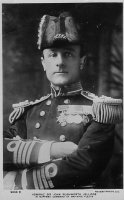
Item 11 Index
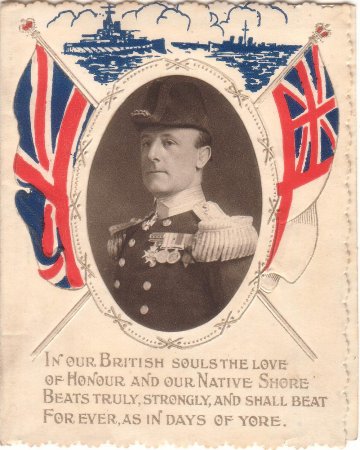
Postcard dated 07 Jun 1915
Admiral Sir John Jellicoe
"Our Boss!"
|
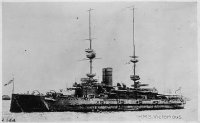
Item 12 Index
Postcard dated 20 May 1916
HMS Victorious
"(Repair Ship) Battle Fleet"
|
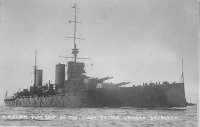
Item 13 Index
Postcard dated 23 May 1916?
HMS Lion

Co Mrs Tuemy?
Montague House,
45 St Pauls Rd
Southsea

Miss Dorothy Doxey,
Home & Colonial College,
Wood Green,
London

"Dear Dorothy,
              You will
see by above address that
I am once again in the old
spot and a fresh address
for a short time as I
think we are going abroad
Give my love to Madge? and
same to yourself.
Billy"
|
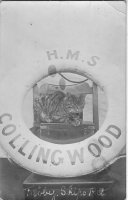
Item 14 Index
Postcard dated 22 Apr 1917
HMS Collingwood, ships cat

"My dear Ena,
             Another PC to the collection &
thought it might interest - a photo of
our pussy aboard & suppose you've been
busy removing and helping Ma.
How did you get on in the competition?
My best love,
Your affectinate,
Willie"
|
Item 15 Index
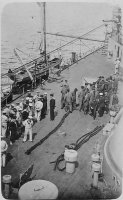
Postcard dated Jun 1917
HMS Emperor of India, deck scene

"Port Side"
|
Item 16 Index
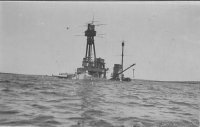
Postcard dated 19 Aug 1919
SMS Hindenbergh (half sunk)

"Scapa Flow"
|
Item 17 Index
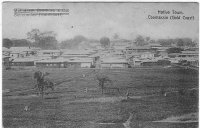
Postcard dated 29 May 1924
Coomassie, Gold Coast, West Africa
(Kumasi, Ghana)
"Where W Doxey bought Gold shares"

"My dear mother,
               Have arrived at last
Hope you have not worried yourself too much
over me.
I will write you a longer letter later.
     Your affectionate son,
              Billie
|
Item 18 Index
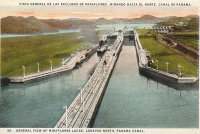
Postcard dated 27 Aug 1925
Miraflores Lock, Panana Canal

Miss D Doxey,
107 Bannercross Rd,
Ecclesall,
Sheffield
England

"Dear Dorothy,
             This is
the place to come
for a Turkish Bath.
Its hotter than H---
    Love,
     Billie"
|
Item 19 Index
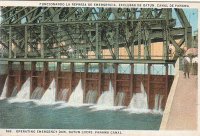
Postcard dated 27 Aug 1925
Gatun Locks, Panama Canal

Miss L Doxey,
107 Bannercross Rd
Ecclesall,
Sheffield,
England

"Dear Lucie,
            I am
fed up with all
my Bairns I am
escorting out to Chile.
We nearly all got
locked up in Cuba.
       Billie"
|
Item 20 Index
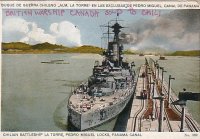
Postcard dated 20 Aug 1925
Chilian Battleship La Torre,
Pedro Miguel locks, Panama Canal

Mr A Doxey,
107 Bannercross Rd
Ecclesall,
Sheffield,
England

"Dear Dad,
         On the other
side you'll see one
of my old ships at
Scapa Flow the
'Canada' now belonging
to Chile locking? the
Panama Canal.
    Billie
The Pacific Ocean is 6 inches
higher than the Atlantic at Panama"
|
Item 21 Index
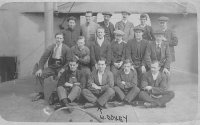
Postcard dated (no date)
Group of 16 men

W Doxey indicated
|
Item 22 Index
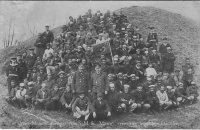
Postcard (no date)
Large group of men with Turkish? flag
"Inder=Mannschaften der von SMS 'Mowe'
versenkten feindlichen Dampfer"
[Indians = Crew of the enemy steamer
sunk by SMS Mowe]
|
Item 23 Index
Postcard (no date)
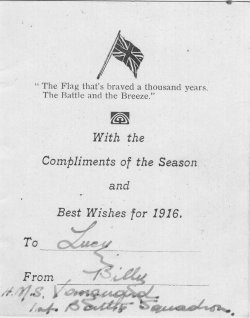
HMS Vanguard
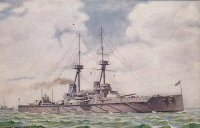
|
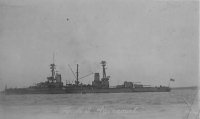
Item 24 Index
Postcard (no date)
HMS Agincourt
|
Item 25 Index
Postcard (no date)
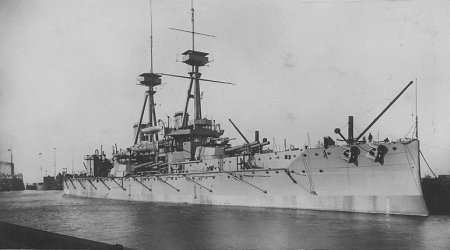
HMS Victorious
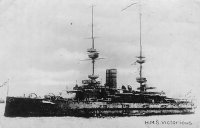
|
Item 26 Index
Postcard (no date)
HMS Agincourt
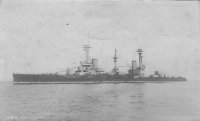
|
Item 27 Index
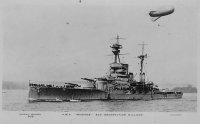
Postcard (no date)
HMS Revenge and observation balloon
|
Item 28 Index
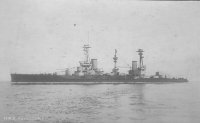
Postcard (no date)
HMS Agincourt
|
Item 29 Index
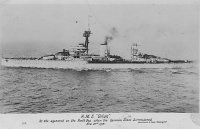
Postcard (no date)
HMS Orion
As she appeared in the North Sea
when the German Fleet surrendered
21 Nov 1918
|
Item 30 Index
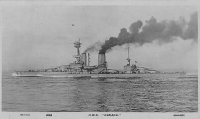
Postcard (no date)
HMS Canada
|
Item 31 Index
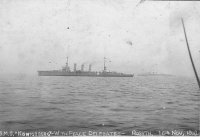
Postcard (no date)
SMS Konigsberg with peace delegates
Rosyth 16 Nov 1918
|
Item 32 Index
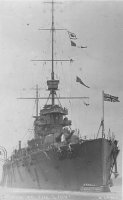
Postcard (no date)
HMS Lion
|
Item 33 Index
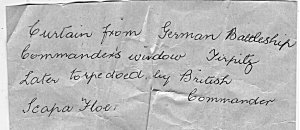
Green silk 490 mms x 410 mms
"Curtain from German Battleship
Commander's window, Tirpitz
Later torpedoed by British
Commander Scapa Flow"
|
Item 34 Index
Cap band
HMS Victorious

|
| 
 All Rights Reserved.